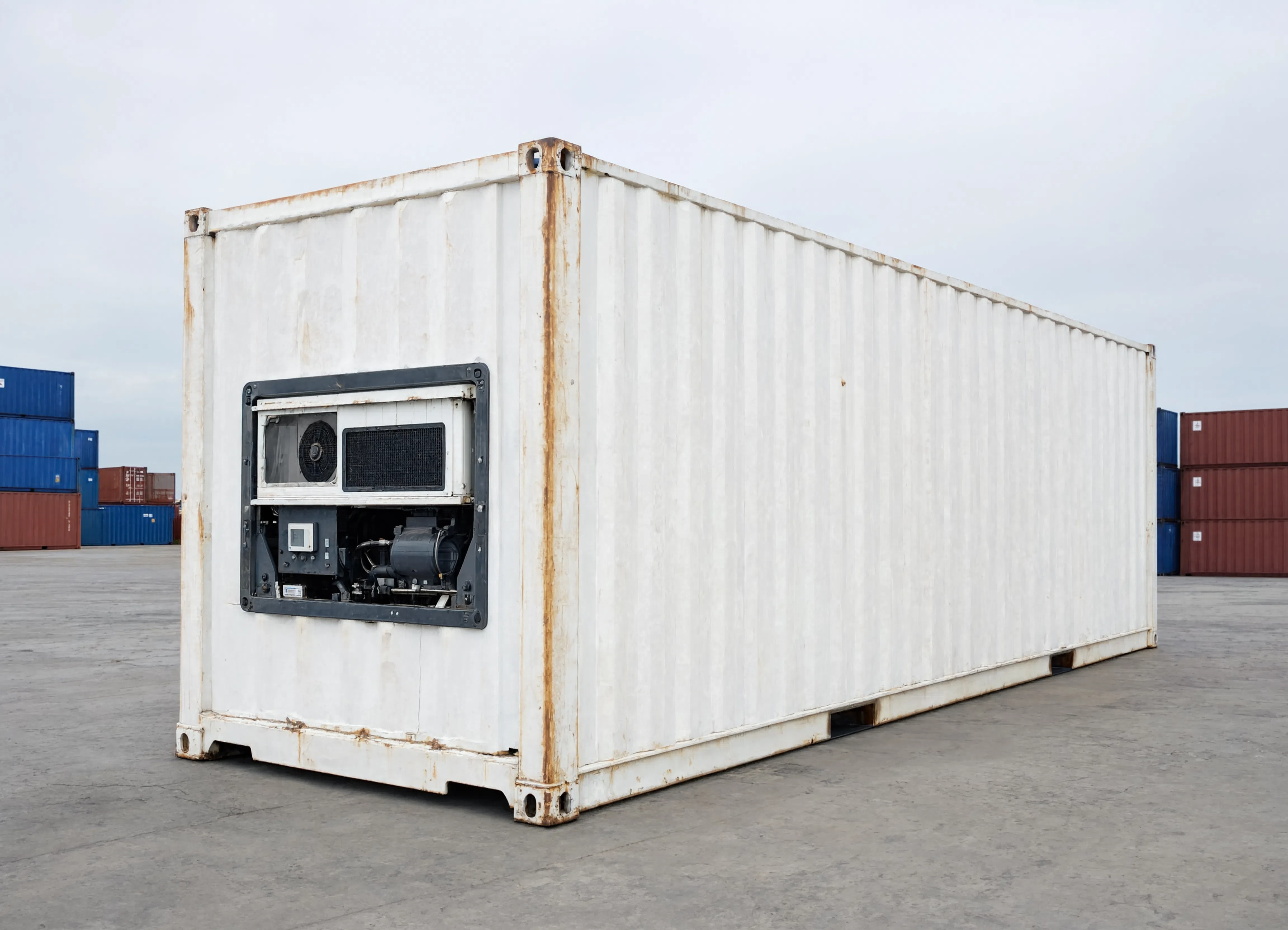
Between £4,000 and £6,500 ex VAT (add 20% VAT on top), the used Grade B 20ft reefer is where the price of a refrigerated container turns almost entirely on the bodywork. The fridge unit itself is run up to temperature and documented like any other grade. That gap — between what you see and what you pay for — is the whole point of this configuration.
What “Grade B” actually covers
A box that has done its job. Handling dents on the posts, faded or patch-repaired paint, rust pitting on the corrugated steel, marked door gaskets, a scored floor. None of that touches the insulation or the cold production. The refrigeration unit — Carrier, Thermo King, Daikin or Star Cool — gets the same test as any other, and its PTI should be under three months old: that is the document that matters. A well-kept Grade B offers the same 10 to 15 years of remaining service as a Grade A, the same -25°C to +25°C range, and the same draw of 85 to 95 kWh a day at +2°C — apply your own electricity tariff to that. The cold ignores the cosmetics. Compare grades side by side on our prices page.
The jobs where looks cost nothing
The back of a restaurant yard, a grower’s seasonal store, a site buffer, the rear of a laboratory, a wholesaler’s overflow cold room: in each case the container is seen by your team and no one else. The 20ft’s roughly 28 m³ and 10 to 11 pallet spaces cover most of these needs, in a footprint of 6.06 by 2.44 metres. A reefer’s interior is tighter than a dry box of the same size — the insulation takes its thickness off the walls, ceiling and floor, leaving about 5.44 by 2.29 metres inside. Against a Grade A of the same size, the money you save here funds years of annual servicing, or a good part of the delivery. On a unit that sits put and is never shown, it is the most rational buy in the catalogue.
When Grade B is the wrong call
Three things push you off Grade B. First, structural corrosion: surface rust brushes and repaints, but rust that perforates a rail or floods a panel’s foam does not — our used buying guide walks the inspection. Second, image: a point of sale, an event, anything a customer sees calls for a Grade A or a one-trip unit. Third, short use: under 18 to 24 months of continuous operation, hiring stays more logical than buying, whatever the grade. And if you do not need active cooling at all, an insulated non-operational 20ft costs less — no sense paying for a unit you will not plug in.
Specifications
| Size | 20ft |
|---|---|
| Usable volume | ~28 m³ |
| Capacity | 10-11 |
| Internal dimensions | ≈ 5,44 × 2,29 × 2,27 m |
| Temperature range | -25 °C / +25 °C |
| Condition | Class B |
| Power supply | Three-phase 380/400 V, 32 A CEE plug (5-pin) |
| Common refrigeration units | Carrier, Thermo King, Daikin, Star Cool |
| Typical use | restaurant, butcher, caterer, brasserie |
What "Class B" means
Visible signs of use (dents, surface corrosion) but a working, tested refrigeration unit. The best cooling-to-price ratio for seasonal use.
A standard reefer covers both modes: it's a setpoint to adjust, not a different product. It also heats, up to +25°C (frost-free storage).
What drives the price
- The refrigeration unit's running hours — the top factor on the used market, body condition being equal.
- The make of the unit — parts availability matters more than the name itself.
- The condition of the body — corrosion, door seals, flooring marked by forklifts.
- The region and site access — delivery by crane lorry costs £700 to £1,700.
EuroReefer does not sell containers. We hold no stock and run no depot: the ranges above are ballpark figures observed on the European market, not an offer of sale. We pass your enquiry on to specialist suppliers, who contact you directly if they can meet it.
Similar references
-
20ft Used Grade A Reefer
-
20ft Used Reefer — Grade C (Sold as Seen)
-
20ft One-Trip Reefer (New)
-
Insulated 20ft Container
Frequently asked questions
Does a Grade B reefer hold temperature as well as a Grade A?
Yes, if the unit is sound. What separates a Grade B from a Grade A is the bodywork — dents, faded paint, surface rust — not the insulation or the refrigeration. A well-kept Grade B 20ft holds the same -25°C to +25°C range and draws the same 85 to 95 kWh a day at +2°C. Just insist on a PTI dated under three months.
How do I tell surface rust from structural corrosion?
Surface rust pits the corrugated steel and cleans up with a wire brush and paint — it is cosmetic. Structural corrosion swells, flakes and perforates, and gathers on the bottom rails, floor cross-members and corner castings. A panel that sounds hollow, or whose foam is waterlogged, cannot be repaired: the insulation is gone, and no respray brings it back.
Will a Grade B resell reasonably?
It resells as Grade B or C, never better — appearance does not improve with age. If exit value matters to your sums, a Grade A of the same size holds more of its worth over a few years. For a container kept to the end of its 10 to 15 years of remaining service, resale barely enters the calculation at all.