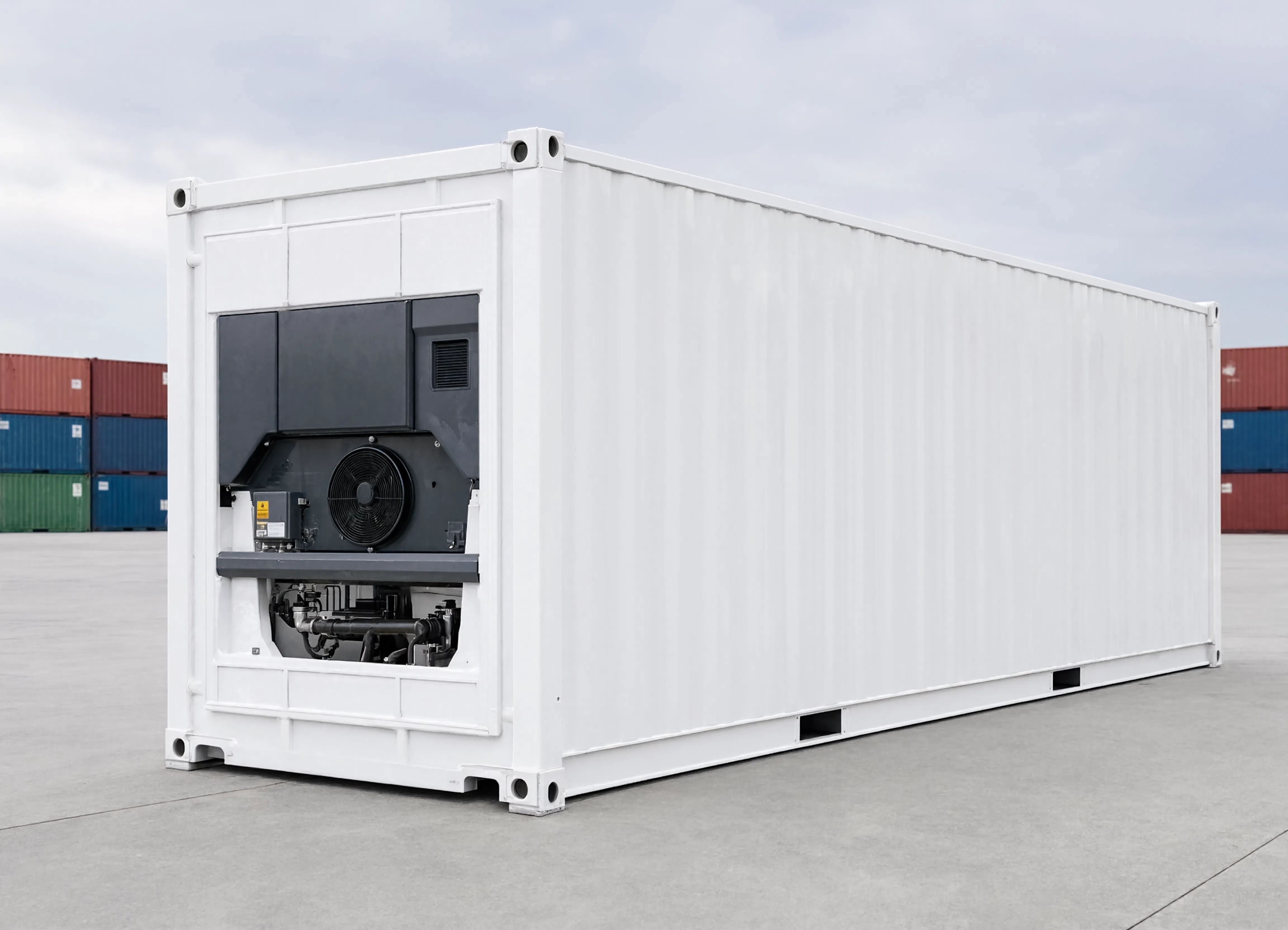
At £15,000 to £25,000 ex VAT — add 20% VAT — a one-trip 20ft reefer sits at the top of the market, and for a specific reason: it is genuinely new. The refrigeration unit has never worked a duty cycle in service, the panels have never been repaired, and the only journey on the clock is the single loaded sailing that brought it from the factory to Europe. Everything below explains when that premium is money well spent — and when it is money thrown at a box no one will ever look at.
Why the box travels loaded once
Manufacturers build reefers in Asia; shipping an empty one to Europe wastes a slot, so a ‘one-trip’ unit carries a paying cargo on its maiden voyage instead. It arrives essentially factory-fresh, with perhaps a few handling scuffs from that single trip — not the dents, faded paint or scored floor that mark a used Grade B. You get the current-generation fridge unit — Carrier, Thermo King, Daikin or Star Cool — the full -25°C to +25°C range, and the longest service life of anything in the catalogue, since none of it has been spent yet. The 20ft format gives you roughly 28 m³ and 10 to 11 pallet spaces, 6.06 by 2.44 metres on the ground, about 5.44 by 2.29 metres inside once the insulation takes its thickness.
When a one-trip earns its price
Three buyers should look here. Anyone whose container is seen — a shopfront cold store, an event unit, a branded food-service base, a showroom demo — because appearance is part of the product. Anyone who needs a clean pedigree on paper: a pharma or laboratory cold chain that documents every asset. And anyone keeping the box for its full working life: a used unit has 10 to 15 years of service left, a one-trip has all of it, and it holds resale value better than any grade. If you plan continuous use well beyond the 18 to 24 month point where hiring stops making sense, buying new is the buy that ages best.
When it is the wrong box
For storage no customer ever sees, a one-trip is hard to justify — a used Grade A or B, checked with our used buying guide, holds the same cold, draws the same 85 to 95 kWh a day at +2°C, and costs a fraction; browse both on our prices page. For anything under 18 to 24 months of use, hire rather than buy. And do not reach for a super-freezer version (-60°C to -70°C) unless your product truly needs it — it is rare and dearer, and most cargo never goes below the standard -25°C. Pay the one-trip premium for what it delivers: presentation, pedigree and years — not for a box that will sit in a yard out of sight.
Specifications
| Size | 20ft |
|---|---|
| Usable volume | ~28 m³ |
| Capacity | 10-11 |
| Internal dimensions | ≈ 5,44 × 2,29 × 2,27 m |
| Temperature range | -25 °C / +25 °C |
| Condition | New |
| Power supply | Three-phase 380/400 V, 32 A CEE plug (5-pin) |
| Common refrigeration units | Carrier, Thermo King, Daikin, Star Cool |
| Typical use | restaurant, butcher, caterer, brasserie |
What "New" means
A container that has made only one sea voyage before being put up for sale. Recent refrigeration unit, very few running hours, intact body.
A standard reefer covers both modes: it's a setpoint to adjust, not a different product. It also heats, up to +25°C (frost-free storage).
What drives the price
- The refrigeration unit's running hours — the top factor on the used market, body condition being equal.
- The make of the unit — parts availability matters more than the name itself.
- The condition of the body — corrosion, door seals, flooring marked by forklifts.
- The region and site access — delivery by crane lorry costs £700 to £1,700.
EuroReefer does not sell containers. We hold no stock and run no depot: the ranges above are ballpark figures observed on the European market, not an offer of sale. We pass your enquiry on to specialist suppliers, who contact you directly if they can meet it.
Similar references
-
20ft Used Grade A Reefer
-
20ft Refrigerated Container — Used, Grade B
-
20ft Used Reefer — Grade C (Sold as Seen)
-
Insulated 20ft Container
Frequently asked questions
What does 'one-trip' actually mean?
A one-trip reefer is built new, then loaded with a single paying cargo for its first and only sailing to Europe — cheaper for the maker than shipping it empty. It reaches you essentially factory-fresh: current fridge unit, unrepaired panels, full service life ahead. Expect a handful of transit scuffs from that one voyage, not the wear of a used box; 'one-trip' means nearly new, not sealed-in-plastic new.
Is a one-trip worth roughly twice the price of a used Grade A?
It depends entirely on the job. New runs about two to four times a Grade A of the same size, so for storage your customers never see, the gap is hard to defend — a sound used unit holds the same -25°C to +25°C cold. Where a one-trip pays back is visibility, a documented pedigree, and long ownership: kept for its full life, it also resells better than any used grade.
Does a one-trip come with a warranty?
Not automatically — any cover comes from the supplier, not from the container being new, so ask what is offered and get it in writing before you buy. In practice a one-trip carries a current-generation Carrier, Thermo King, Daikin or Star Cool unit, which keeps spare parts and service straightforward for years, but that is availability, not a guarantee. Confirm the terms with whoever supplies the box.