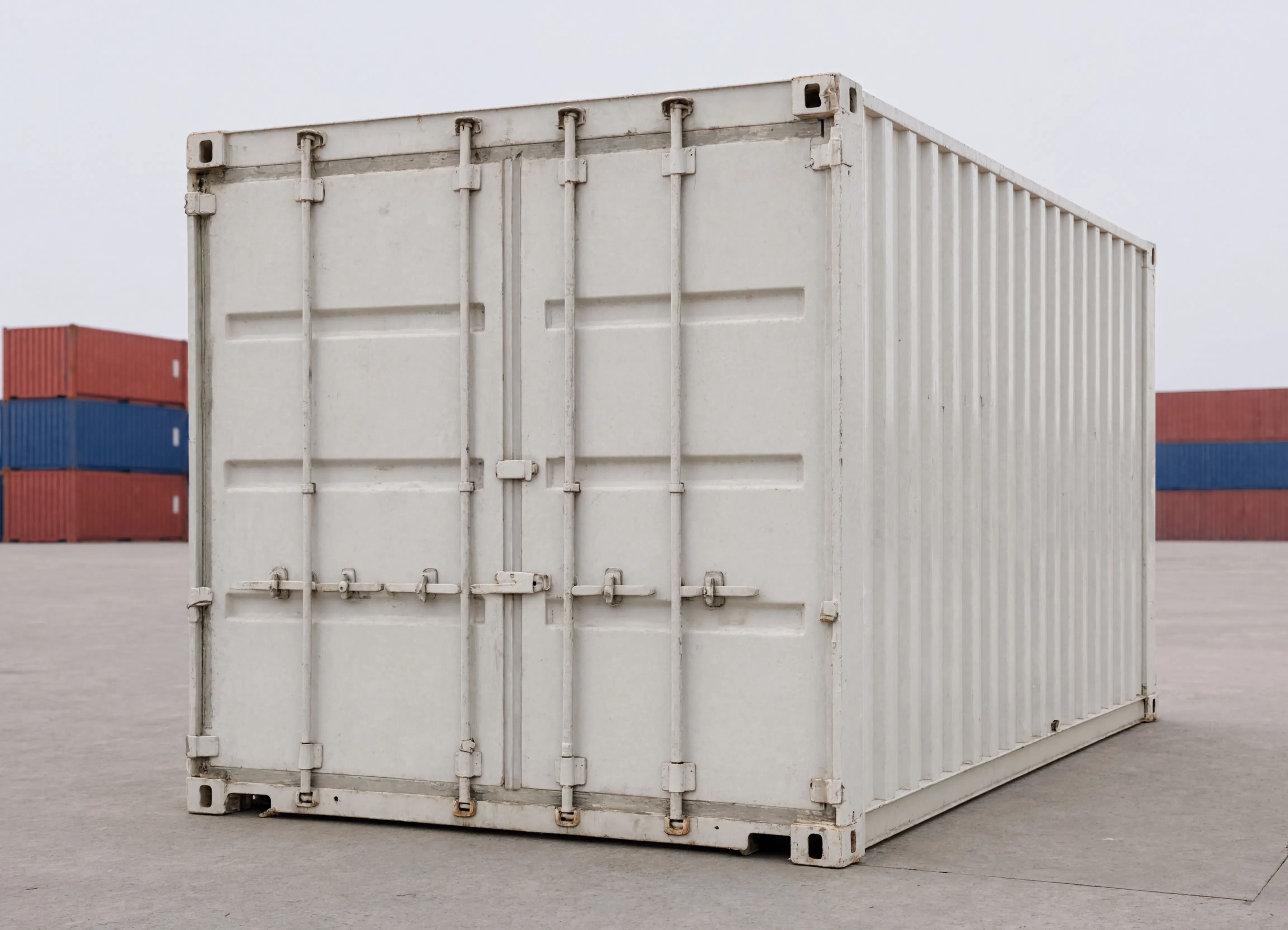
At £2,000 to £4,500 ex VAT (add 20% VAT), an insulated 20ft is the cheapest way into a temperature-protected steel box — 30 to 50% below a working Grade B reefer of the same size. The saving is not on the shell: you get the same 6.06 by 2.44 metre footprint, the same roughly 28 m³ and 10 to 11 pallet spaces. What you do not get is a live refrigeration unit, and that single absence is the whole configuration.
What an insulated box does, and does not do
Insulation slows heat; it does not remove it. An insulated 20ft has no compressor, no plug and no CEE socket, so it draws no electricity — nothing to run, no daily kWh to cost against a tariff. What the panels give you is thermal inertia: they blunt the swing between a cold night and a hot afternoon, and hold it far steadier than a dry container or a shed. But the box cannot pull a temperature down or hold a setpoint. Load it at ambient and it stays near ambient, drifting slowly. If your goods must reach and stay at +2°C or -18°C, this is the wrong box — you need a working reefer, and our prices page sets the two side by side.
Where the insulated 20ft earns its keep
Two buyers get the most from it. The first wants a shell to fit their own cooling to — a split unit, a monoblock, a hired plant — and would rather not pay for a tired fridge they mean to strip out anyway. The second needs passive protection: keeping paint, bottled stock or produce off the frost in winter and out of direct summer heat, where the swing matters more than any exact figure. A grower’s overflow store or a brewer’s stock buffer both fit. The interior runs about 5.44 by 2.29 metres and 2.27 metres high — tighter than a dry 20ft, because the insulation eats into every surface. Browse configurations in the catalogue.
What to check before you buy
There is no refrigeration unit here, so a PTI means nothing — inspect the insulation instead. Tap the panels: a hollow note or a soft, spongy patch means the foam has taken water, and a waterlogged panel has lost its insulating value for good. Check the door seals close clean along their length, and look for daylight at the corners. If a dead fridge unit is still bolted to the front, agree who removes it and at whose cost. Marketplaces such as eBay and Gumtree list these boxes too; a professional seller adds a checked-over shell, delivery and someone to call if the insulation proves soaked. Our used buying guide covers the panel checks in full.
Specifications
| Size | 20ft |
|---|---|
| Usable volume | ~28 m³ |
| Capacity | 10-11 |
| Internal dimensions | ≈ 5,44 × 2,29 × 2,27 m |
| Condition | Insulated |
| Typical use | restaurant, butcher, caterer, brasserie |
What "Insulated" means
A former refrigerated container whose refrigeration unit has been removed or is out of service. The insulation is retained: the body slows temperature swings but produces none of its own.
What drives the price
- The refrigeration unit's running hours — the top factor on the used market, body condition being equal.
- The make of the unit — parts availability matters more than the name itself.
- The condition of the body — corrosion, door seals, flooring marked by forklifts.
- The region and site access — delivery by crane lorry costs £700 to £1,700.
EuroReefer does not sell containers. We hold no stock and run no depot: the ranges above are ballpark figures observed on the European market, not an offer of sale. We pass your enquiry on to specialist suppliers, who contact you directly if they can meet it.
Similar references
-
20ft Used Grade A Reefer
-
20ft Refrigerated Container — Used, Grade B
-
20ft Used Reefer — Grade C (Sold as Seen)
-
20ft One-Trip Reefer (New)
Frequently asked questions
Can an insulated container keep my goods cold without power?
Only for a while, and only relative to the outside. With no refrigeration unit it produces no cold — it slows the loss. Load it already cold and the insulation stretches how long the chill lasts; load it warm and it stays warm. For anything that must reach and hold +2°C or -18°C, you need a working reefer, not an insulated shell.
Why is an insulated 20ft cheaper than a used reefer?
Because the expensive, wear-prone part — the Carrier, Thermo King, Daikin or Star Cool refrigeration unit — is either absent or no longer running. You pay for the insulated steel box alone, which puts an insulated 20ft at £2,000 to £4,500 ex VAT, roughly 30 to 50% under a working Grade B of the same size. The trade-off is that you supply the cooling, or do without it.
Can I fit my own refrigeration unit to it later?
That is one of the common reasons to buy one. An insulated 20ft makes a ready-made cold-room shell for a split unit, a monoblock or hired refrigeration plant, and its 5.44 by 2.29 metre interior takes standard racking. Confirm the door seals and panel condition first — a soaked panel undermines whatever unit you bolt on — and factor the cooling plant and its install into your budget.