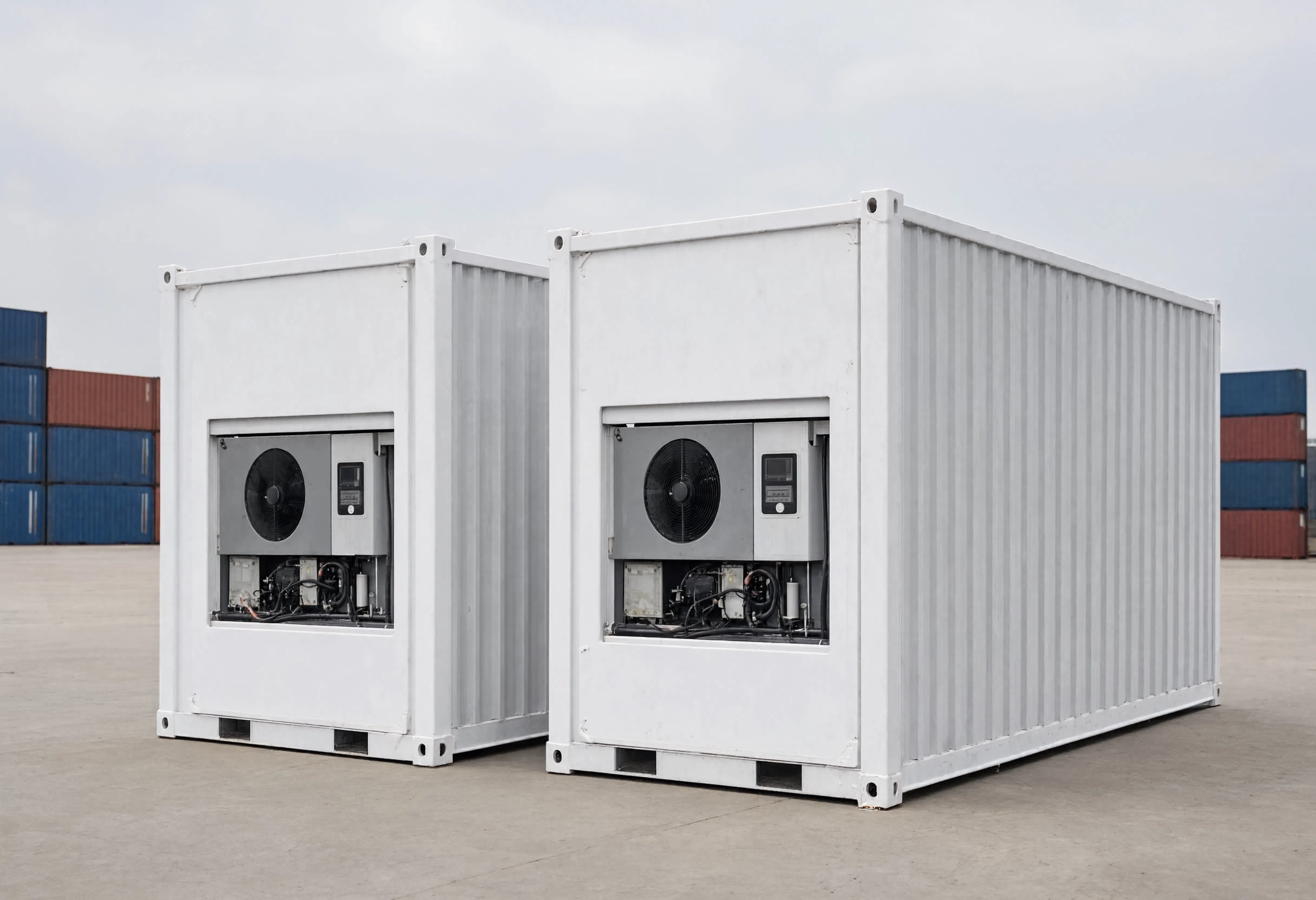
Strip away the shipping and a refrigerated container is something much simpler: a portable, walk-in cold store. It arrives on a lorry, sits on any firm and level surface, plugs into a suitable power supply and holds anywhere between -25 °C and +25 °C — no foundations, no panel assembly, no building work. If you have been searching for a cold storage container, a portable cold room or walk in cold storage hire, you have almost certainly been looking at the same physical product wearing three different names.
Three trades, one box
The UK market for outdoor and temporary cold storage is oddly siloed. Container dealers sell and hire “reefers” — insulated ISO boxes with an integral refrigeration unit, described in shipping vocabulary. Cold storage firms offer “portable cold rooms” for hire, which are frequently those very containers under a friendlier label. Event companies supply chillers for festivals, weddings and film sets, priced by the weekend. Each vertical describes, prices and sells the product in its own dialect, and few cover the whole journey from a fortnight’s overflow to buying a used unit outright.
That whole journey is what this site maps: hire and purchase, chilled and frozen, short jobs and permanent installations — so you can compare the three verticals against each other rather than shopping inside one of them by accident.
Container or modular cold room?
The genuine alternative to a cold storage container is a modular cold room, and the choice usually decides itself on one question: indoors or out?
| Refrigerated container | Modular cold room | |
|---|---|---|
| Where it lives | Outdoors, on firm level ground | Indoors, inside an existing building |
| Installation | Delivered in one piece; plug in and switch on | Assembled on site from insulated panels |
| Moving it | Can be relocated, re-hired or resold | Fixed once built |
| Sizing | Fixed ISO formats | Made to measure |
| Typical role | Overflow, seasonal peaks, outdoor sites | Permanent capacity inside a kitchen or warehouse |
If you have spare floor space inside a building and the need is permanent, a made-to-measure cold room uses that space better. If the storage must live outside, arrive quickly, move site later or be sold on when the need passes, the container wins — it is a machine you place, not a room you build.
Sizes: from four pallets to twenty-three
| Format | External (L × W × H) | Internal | Capacity |
|---|---|---|---|
| 10 ft | ≈ 2.99 × 2.44 × 2.59 m | usable length notably shorter | ~15 m³, 4–5 pallets |
| 20 ft | 6.06 × 2.44 × 2.59 m | ≈ 5.44 × 2.29 × 2.27 m | ~28 m³, 10–11 pallets |
| 40 ft high cube | 12.19 × 2.44 × 2.90 m | ≈ 11.58 × 2.29 × 2.55 m | ~67 m³, ~23 pallets |
Two caveats worth knowing before you measure your yard. A refrigerated container is smaller inside than a dry container of the same format, because the insulation takes thickness out of the walls, ceiling and floor. And on the 10 ft format, the 2.99 m is an over-all figure: the refrigeration unit and insulation consume a proportionally large share of that length, so treat the small format as a four-to-five-pallet cold room, not a three-metre one.
What walk-in cold storage hire costs
On the UK market, long-term hire starts at around £12 a day ex VAT, with the day rate falling as the format shrinks and the commitment grows. One habit of the trade deserves honesty: minimum hire periods of around 90 days are common, because transport at each end dominates the economics of a short job. Genuine short-term hire does exist — some suppliers serve events and seasonal peaks — but expect a noticeably higher day rate over a week than over a year. That is degressive pricing, not sharp practice.
All figures here are ex VAT; UK VAT applies at 20 %.
Buying instead: used and one-trip prices
Once a need stops being temporary, the arithmetic changes. A working used refrigerated container typically trades at £4,500–£7,500 ex VAT on the UK market, while a new “one-trip” unit — built, loaded once, then sold — runs £18,995–£22,500 ex VAT. The threshold the industry works to: beyond roughly 18 to 24 months of continuous use, buying tends to overtake hiring.
On the used market, the vocabulary that matters is short. Units are graded into classes A, B and C; a class A machine is typically under 12 years old and a sound used unit has 10 to 15 years of service left. Ask for a PTI (Pre-Trip Inspection) report less than three months old, and note the refrigeration machinery brand — Carrier, Thermo King, Daikin and Star Cool dominate, and spares availability follows the brand.
Power: the question to settle first
Most refrigerated containers need a three-phase 380/400 V supply through a 5-pin 32 A CEE connector; some small formats run on single-phase 230 V. Consumption lands around 70–170 kWh a day depending on size and set point, with frozen operation drawing more than chilled. If your site has three-phase in place, connection is trivial; if it does not, resolve that before anything is delivered. Our power supply guide walks through the options.
From reading to quotes
EuroReefer is an editorial comparison site — we hold no stock and operate no fleet. Describe what you need once and we pass your request to specialist suppliers, who contact you directly if they can meet your requirement. When the quotes arrive, compare like with like: day rate against minimum period, what delivery and collection cost, and whether the price shown is ex VAT. Request your quotes here — it costs nothing and commits you to nothing.
Frequently asked questions
Is a cold storage container the same as a walk-in cold room?
Functionally, yes — for outdoor use. A refrigerated container is a portable, walk-in cold store: insulated on all six sides, with an integral refrigeration unit and a lockable door you walk through. The difference is with modular cold rooms, which are assembled indoors from insulated panels and sized to fit an existing space. A container arrives in one piece, sits outside and can be moved or resold later.
Can I hire a cold storage container for less than 90 days?
Often, yes — but not with every supplier. Minimum hire periods of around 90 days are common in the container trade, because delivery and collection dominate the cost of a short job. Short-term and event hire does exist with some suppliers, at a higher day rate than long-term hire. State your dates clearly when requesting quotes so suppliers who cannot accommodate them do not waste your time.
How much power does a cold storage container use?
Expect roughly 70–170 kWh a day depending on the size of the unit and the set temperature — frozen operation draws more than chilled, and hot weather or frequent door openings push consumption up. Most units need a three-phase 380/400 V supply through a 5-pin 32 A CEE connector, though some small formats run on single-phase 230 V. Check your supply before delivery, not after.
What temperatures can a cold storage container hold?
Standard refrigerated containers operate between -25 °C and +25 °C, which covers chilled produce, frozen goods and heated or ambient-controlled storage in one machine. Super-freezer units reaching -60 °C or below exist for specialist cargo such as tuna, but they are rare and considerably more expensive. For everyday chilled or frozen storage, the standard range is more than sufficient.
Do I need planning permission for a cold storage container?
It depends on your site, how long the container stays and what your local planning authority considers a temporary structure. Rules differ between councils, and factors such as conservation areas or proximity to boundaries can change the answer. Before committing to a long placement, check with your local planning authority — a short phone call is cheaper than a retrospective application.