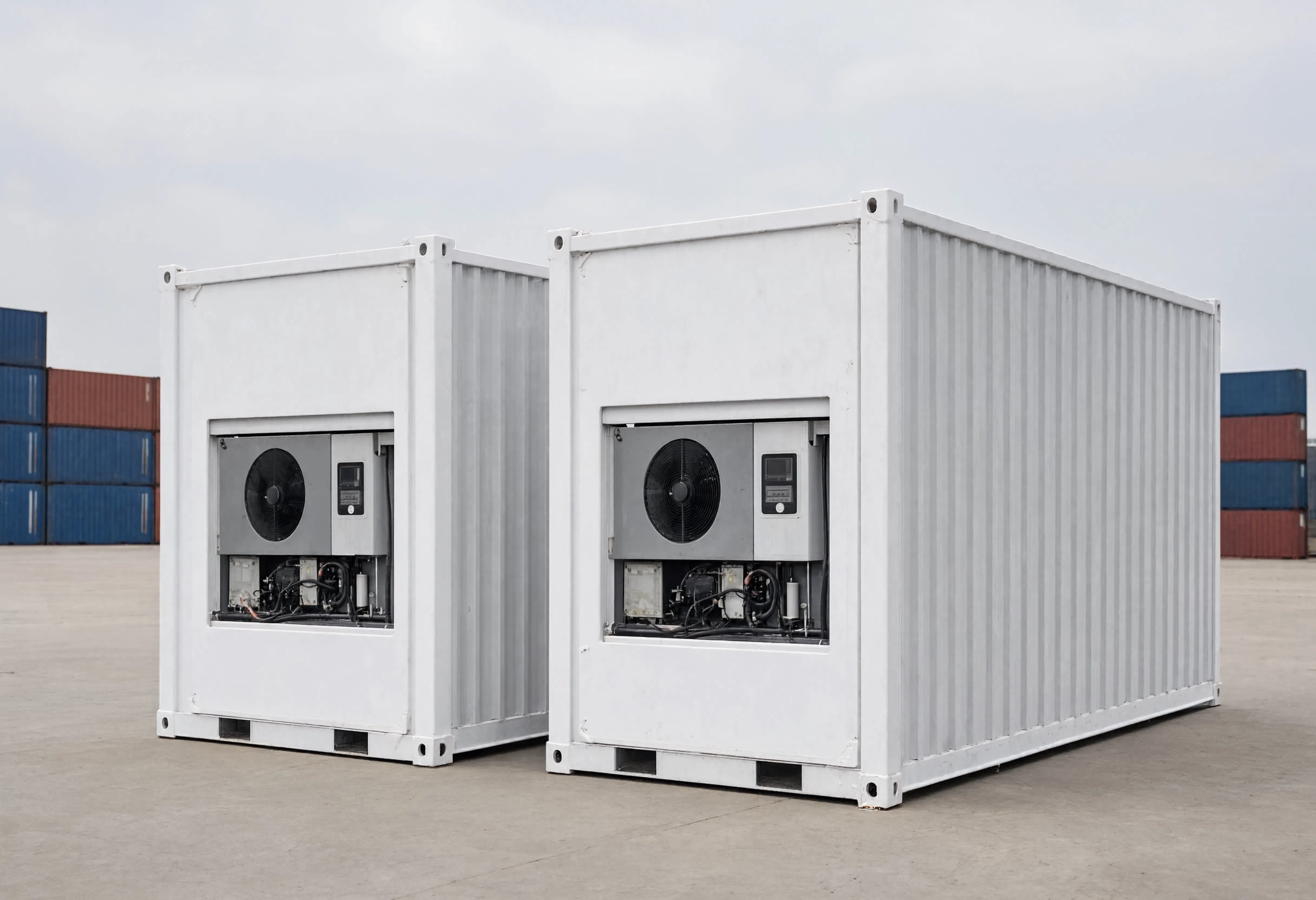
A used refrigerated container — a used reefer, in trade shorthand — is the most economical way to put serious, weatherproof cold storage on your own site. In the UK, a working second-hand refrigerated container typically sells for £4,500 to £7,500 ex VAT, against £18,995 to £22,500 ex VAT for a new one-trip unit — and the machinery is the same family of Carrier, Thermo King, Daikin and Star Cool units either way. This page explains where used reefers come from, how grading works, what a PTI test proves, and what to check before you commit.
Where used reefer containers come from
Almost every used reefer container on the UK market is ex-marine: retired from shipping-line service after years carrying chilled and frozen cargo at sea. That origin is a feature, not a flaw — these containers are built to ISO standards for continuous duty in a harsh environment. Once retired, they are tested, graded and resold for static cold storage on land.
A used reefer in good order can typically give a further 10 to 15 years of service. Remaining life depends less on age than on how the refrigeration unit has been maintained — which is why test results matter more than the year on the data plate.
What a used refrigerated container costs in the UK
| Option | Typical price (ex VAT) |
|---|---|
| Used refrigerated container, working order | £4,500 – £7,500 |
| New one-trip reefer | £18,995 – £22,500 |
| Non-operational reefer (insulated box only) | varies — see non-operational reefers |
These figures are indicative market observations, not a tariff. Within the used range, price follows size, grade, the age and make of the refrigeration unit, and whether a recent test report is supplied. VAT at 20% applies on top, and delivery is quoted separately depending on distance and site access.
One decision to make first: for less than roughly 18 to 24 months of continuous use, hiring a refrigerated container usually works out better than owning one — many hire firms apply 90-day minimum terms, though shorter hire does exist. Beyond that threshold, purchase generally wins.
Grades explained: A, B and C
- Grade A — the youngest units, generally under 12 years old, with the best cosmetic and mechanical condition. The usual choice for food-grade storage.
- Grade B — older or more marked, but in working order. Often sensible value for general chilled or frozen storage, provided the unit passes a recent test.
- Grade C — sold as seen, typically with known faults. Best treated as a project machine or a donor for spares.
Grading describes condition, not certification — no single body polices it. Ask what a seller’s grading covers, and let the test results, not the letter, carry the decision.
The PTI test: your main safeguard
PTI stands for Pre-Trip Inspection, the container industry’s standard function test. It runs the refrigeration unit through its operating cycle and confirms the machine reaches and holds its set point. Ask for a PTI report less than three months old — anything older says little about the unit’s behaviour today. Better still, ask for a cold run at the temperature you intend to use: standard reefers operate from -25 °C to +25 °C, so there is no reason not to test at your actual set point.
Fridge unit makes: Carrier, Thermo King, Daikin, Star Cool
Four makes account for most refrigeration units on ex-marine containers: Carrier, Thermo King, Daikin and Star Cool. All four are proven over years at sea. What differs for a buyer is the availability of spare parts, how easily you can find an engineer familiar with the unit locally, and the individual machine’s service history. There is no best make in the abstract: a well-documented unit from any of the four beats a poorly documented one from any other.
What to check before you buy
- A PTI report under three months old, naming the unit tested.
- A cold run at your target temperature, documented before dispatch.
- Door seals and hinges — worn gaskets leak cold air and load the machine.
- Interior panels and floor — dents and repairs that compromise airtightness or hygiene.
- Service history and running hours of the refrigeration unit.
- Power compatibility — standard reefers take three-phase 380/400 V through a 5-pin 32 A CEE plug; some smaller units run on single-phase 230 V. Confirm what your site can supply.
- What the price includes — delivery and offloading are usually quoted separately.
For a step-by-step version of this checklist, see our used buying guide.
Buying from a specialist vs a marketplace
Both are legitimate routes, and plenty of used reefers change hands through general marketplaces, often at attractive prices. What a specialist dealer adds is process: pre-sale testing with a documented PTI, the option of a cold run before dispatch, graded stock, sometimes a warranty on the unit, arranged delivery, and a counterpart to go back to if something is wrong. How much that is worth depends on your appetite for risk and whether you can assess a refrigeration unit yourself.
Sizes: what a used reefer gives you
| Format | External (L × W × H) | Internal (approx.) | Capacity |
|---|---|---|---|
| 10 ft | ≈ 2.99 × 2.44 × 2.59 m | usable length markedly shorter | ~15 m³, 4–5 pallets |
| 20 ft | 6.06 × 2.44 × 2.59 m | ≈ 5.44 × 2.29 × 2.27 m | ~28 m³, 10–11 pallets |
| 40 ft HC | 12.19 × 2.44 × 2.90 m | ≈ 11.58 × 2.29 × 2.55 m | ~67 m³, 23 pallets |
A reefer’s interior is smaller than a dry container’s of the same format: insulation takes thickness from walls, ceiling and floor, and on the 10 ft the unit and insulation eat a proportionally large share of the 2.99 m overall length. The 20 ft, at roughly 3,000 kg tare, is the most widely traded format in the UK — see 20 ft reefers for sale.
Running costs to budget for
Expect a working reefer to draw roughly 70 to 170 kWh per day depending on size and set temperature — holding -18 °C costs more than +2 °C. Budget also for an annual service of the refrigeration unit.
Compare offers before you commit
EuroReefer is an editorial comparison site: we hold no stock and sell nothing ourselves. Describe what you need — size, grade, target temperature, postcode — through our quote form and we pass your request to specialist suppliers, who contact you directly if they can meet your requirement. On a purchase of this size, comparing offers is the cheapest insurance there is.
Frequently asked questions
How much does a used refrigerated container cost in the UK?
Most working used refrigerated containers sell for £4,500 to £7,500 ex VAT in the UK, depending on size, grade, age and the condition of the refrigeration unit. VAT at 20% is added on top, and delivery is quoted separately according to distance and site access. By comparison, a new one-trip reefer typically costs £18,995 to £22,500 ex VAT.
What is a PTI test on a reefer container?
PTI stands for Pre-Trip Inspection, the standard function test used across the container industry. It runs the refrigeration unit through its operating cycle and confirms that it reaches and holds its set temperature. When buying a used reefer, ask for a PTI report less than three months old — an older report tells you little about how the machine behaves today.
How long will a used reefer container last?
A well-maintained used refrigerated container can typically give a further 10 to 15 years of service. Grade A units are generally under 12 years old and show the least wear. Remaining life depends heavily on how the refrigeration unit has been serviced, which is why a recent PTI report and a cold run before purchase matter more than age alone.
What does ex-marine mean?
An ex-marine reefer is a refrigerated container retired from shipping-line service. Built to ISO standards for years of hard use at sea, these units are designed to hold temperature reliably in all weathers. Once decommissioned, they are tested, graded and resold for static cold storage — which is where most used refrigerated containers on the UK market come from.
Should I buy a Grade A or Grade B reefer?
Grade A suits food-grade storage where appearance and reliability matter most: these are the youngest, cleanest units. Grade B can be sound value for less demanding use, provided the refrigeration unit passes a recent PTI. Grade C machines are sold as seen and are best treated as projects or donors for spares. Whatever the grade, judge the container on its test results rather than the label.