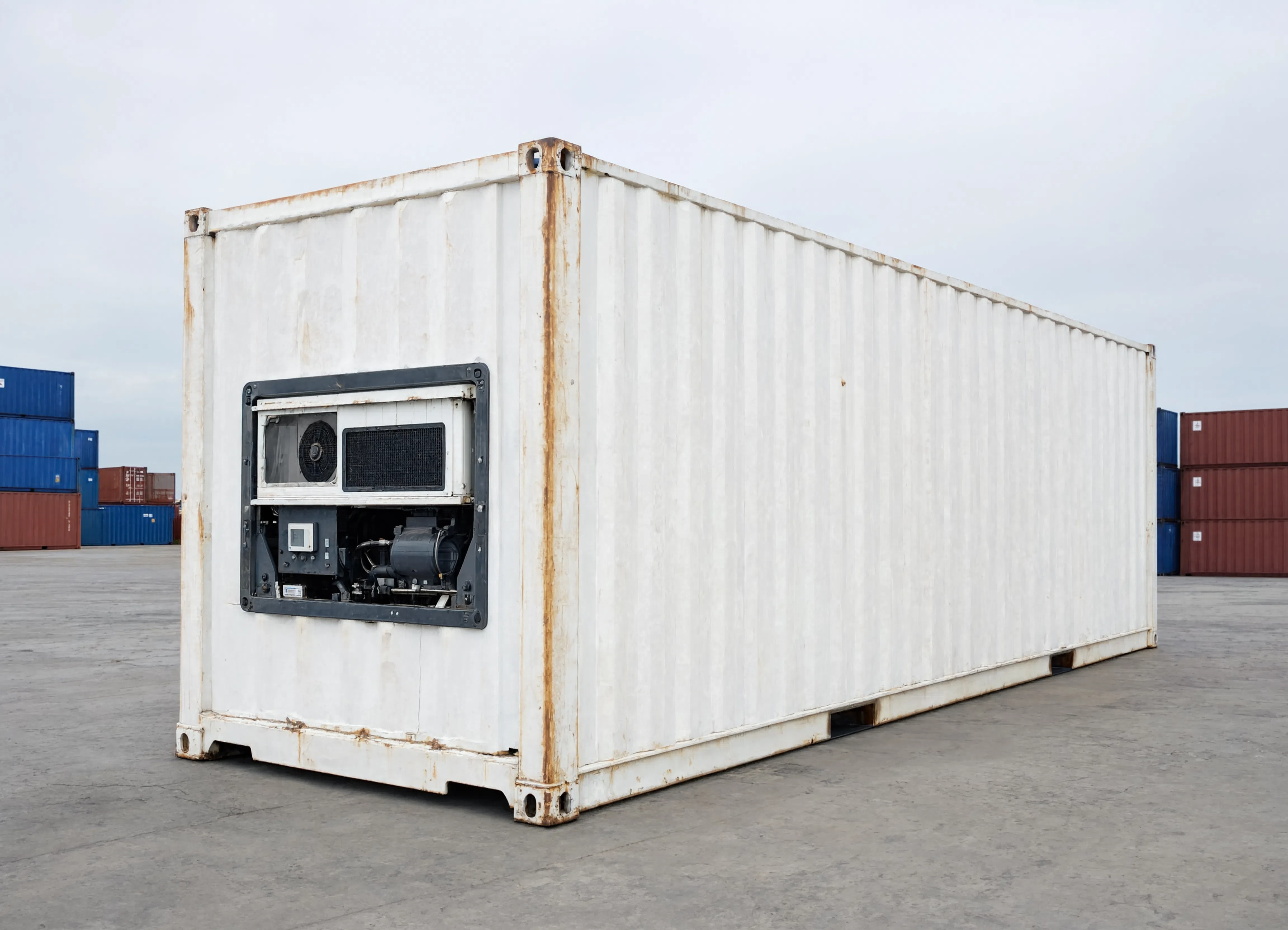
At £7,500 to £10,000 ex VAT — add 20% VAT on top — a Grade A 40ft high-cube reefer set to freezer temperatures is the largest, cleanest used cold box most buyers consider. Grade A means a unit under twelve years old, cosmetically sound, with 10 to 15 years of service still ahead of it. And “freezer” means it is set to negative cold, -18 to -25°C, rather than the +2°C chill most reefers spend their lives at. Three decisions stacked into one box, and each should be a deliberate one.
Who needs 67 m³ of frozen storage
Roughly 67 m³ and 23 pallet spaces, in an exterior footprint of 12.19 by 2.44 metres, standing 2.90 metres tall — the high-cube height is what buys the internal 2.55 metres of clearance. Inside, the insulated shell measures about 11.58 by 2.29 by 2.55 metres: a reefer is always tighter than a dry box the same size — the foam takes its thickness off walls, ceiling and floor. Frozen-food wholesalers, ice-cream and seafood traders, bakeries holding frozen dough, and anyone buffering a cold chain over a peak all reach for this format. If your throughput is smaller, the volume is money spent and then powered for no reason — see the smaller formats in the catalogue.
What negative cold asks of the unit — and your bill
Freezing costs more to run than chilling. Held at -18°C, a 40 high cube draws roughly 190 to 215 kWh a day, against 170 to 190 kWh at +2°C; apply your own tariff. It wants a three-phase 400V, 32A CEE supply, and the compressor sits at the upper end of the 5 to 12 kW band. The group will be a Carrier, Thermo King, Daikin or Star Cool; what matters more than the badge is a PTI under three months old — your evidence it pulls down and holds. The standard range runs -25 to +25°C — judge the machine on that span and on tight door seals, not on any claim of degree-perfect regulation. Compare grades and running figures on our prices page.
When this is the wrong box
Four cases point elsewhere. If you only ever hold produce chilled, running at +2°C — or a smaller reefer — saves electricity daily. If the box is never customer-facing and cosmetics are irrelevant, a Grade B holds the same cold for less. If you will run it under 18 to 24 months, hiring stays the more logical route — UK long-term hire starts around £12 a day, though a 90-day minimum is common. And if you need no active cooling at all, an insulated non-operational box costs far less than a working freezer. The used buying guide walks the checks before you commit.
Specifications
| Size | 40ft high cube |
|---|---|
| Usable volume | ~67 m³ |
| Capacity | 23 |
| Internal dimensions | ≈ 11,58 × 2,29 × 2,55 m |
| Temperature range | -18 °C / -25 °C |
| Condition | Class A |
| Power supply | Three-phase 380/400 V, 32 A CEE plug (5-pin) |
| Common refrigeration units | Carrier, Thermo King, Daikin, Star Cool |
| Typical use | food industry, logistics, supermarket chains |
What "Class A" means
A recent unit — often under 12 years old — with a refrigeration unit in good condition and a lightly marked body. The choice for intensive year-round use.
Same machine, set to sub-zero cooling. Power consumption is higher than in chilled mode.
What drives the price
- The refrigeration unit's running hours — the top factor on the used market, body condition being equal.
- The make of the unit — parts availability matters more than the name itself.
- The condition of the body — corrosion, door seals, flooring marked by forklifts.
- The region and site access — delivery by crane lorry costs £700 to £1,700.
EuroReefer does not sell containers. We hold no stock and run no depot: the ranges above are ballpark figures observed on the European market, not an offer of sale. We pass your enquiry on to specialist suppliers, who contact you directly if they can meet it.
Similar references
-
20ft Used Grade A Reefer
-
20ft Freezer Container (Grade A reefer)
-
40ft High Cube Reefer — Used, Grade A
-
40ft High-Cube Reefer, Used Grade B
Frequently asked questions
How much electricity does a 40ft high-cube reefer use at freezer temperatures?
Held at -18°C, a 40ft high cube draws roughly 190 to 215 kWh a day — noticeably more than the 170 to 190 kWh it uses at +2°C chill, and far more than a 20ft. The compressor sits at the upper end of the 5 to 12 kW band. Apply your own electricity tariff to those figures, and budget for a three-phase 400V, 32A supply.
Is Grade A worth the premium on a freezer that only stores stock?
The premium over a scruffier Grade B buys cleaner bodywork and better resale, not colder cold. A well-kept Grade B holds the same -18 to -25°C and the same 10 to 15 years of remaining service. So if the box sits out of sight and stays to the end of its life, Grade B saves money; if it faces customers or you value exit price, Grade A earns the difference.
Do I need a freezer unit, or would a chilled reefer do?
Every reefer covers the full -25 to +25°C range, so a 'freezer' is simply one you set to negative cold. If you only ever hold produce at +2°C, running it at -18°C wastes electricity — the same 40 high cube costs less to run chilled. Buy for the coldest job you actually have, not the coldest one possible.