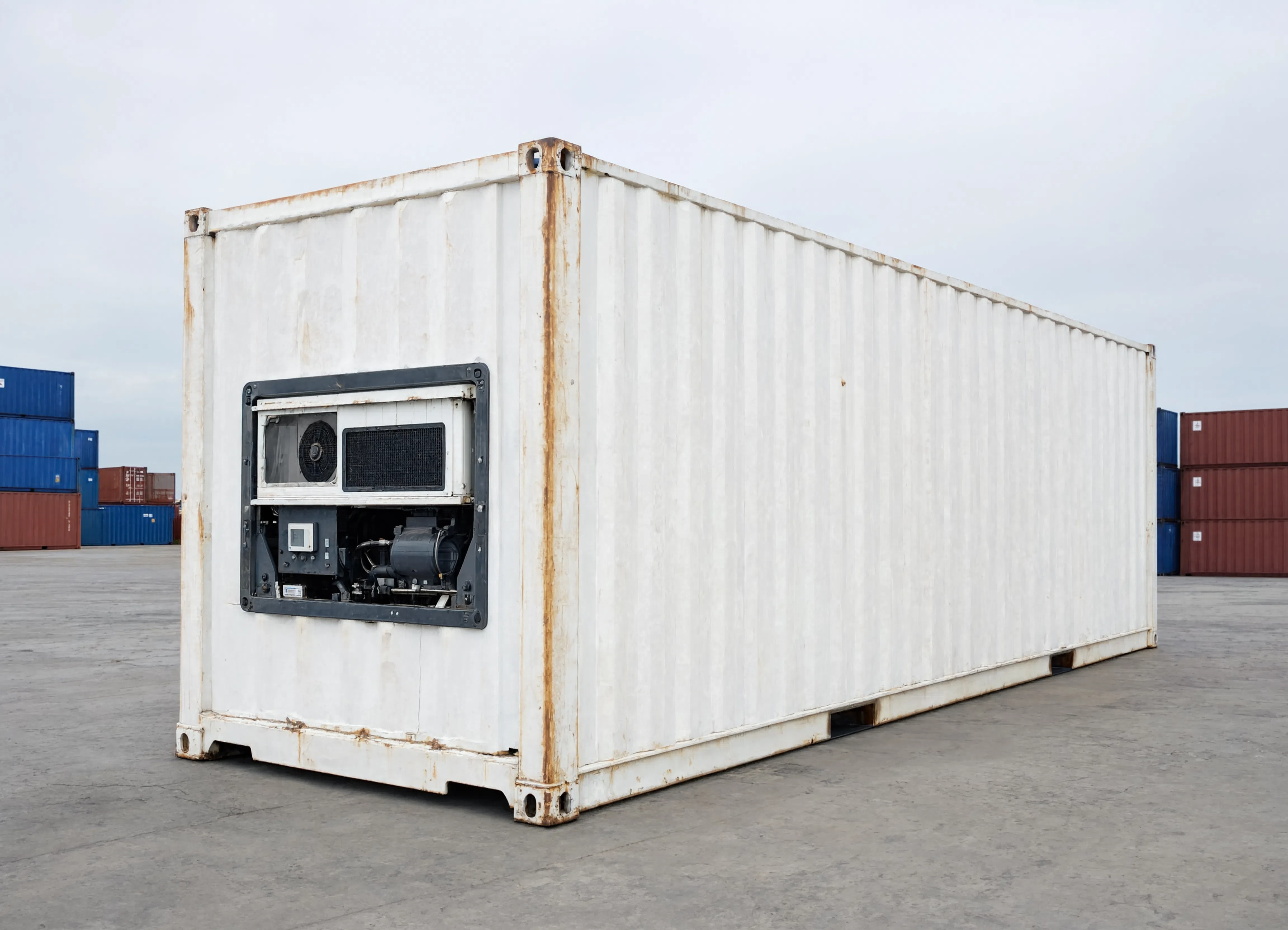
At £7,500 to £10,000 ex VAT — add 20% VAT on top — a used Grade A 40ft high cube is the top of the standard reefer range: the biggest, tallest cold box before one-trip or new. Grade A here means a shell under twelve years old, presentable rather than merely working, carrying a tested, documented refrigeration unit. Behind the doors sit roughly 67 m³ and 23 pallet spaces. This is what you buy when both volume and appearance have to hold up.
The volume, and what the height actually gives you
The high cube’s whole argument is height. Externally it stands 12.19 by 2.44 by 2.90 metres — the 2.90 is what separates it from a standard 40ft. Inside, the insulated reefer body clears about 11.58 by 2.29 by 2.55 metres: a reefer loses more to wall, floor and ceiling insulation than a dry box of the same size, so the interior is always tighter than the steel outline suggests. Even so, that 2.55 m of clear height takes a double-stacked pallet, a tall roll cage or a hanging rail that a standard-height box will not. For 23 pallets of chilled or frozen goods in one footprint, nothing else in the catalogue matches it.
What Grade A buys at this size
A Grade A shell is under twelve years old, with sound paint and straight panels — the difference from a Grade B is the bodywork and the age, not the cold. It still offers the 10 to 15 years of remaining service any sound used reefer does, the same -25°C to +25°C range, and a group from Carrier, Thermo King, Daikin or Star Cool. Insist on a PTI dated under three months: on a 40ft, where the refrigeration works hardest, that recent test matters most. Appearance also holds resale value, which is why Grade A suits anything a customer sees or a unit you may sell on. Our used buying guide walks the inspection.
When a 40ft high cube is the wrong box
Size cuts both ways. If you move 10 or 11 pallets, a 20ft is cheaper to buy and far cheaper to run — a 40ft draws roughly 170 to 190 kWh a day at +2°C against 85 to 95 for the smaller box. A twelve-metre container also needs the room for a crane-truck delivery, which not every yard has. If the box is never shown, a Grade B of the same size saves you around £2,500. Under 18 to 24 months of continuous use, hiring stays the better sum. And if you need only insulated storage without active cooling, a non-operational unit costs less than any working grade. Weigh the options on our prices page.
Specifications
| Size | 40ft high cube |
|---|---|
| Usable volume | ~67 m³ |
| Capacity | 23 |
| Internal dimensions | ≈ 11,58 × 2,29 × 2,55 m |
| Temperature range | -25 °C / +25 °C |
| Condition | Class A |
| Power supply | Three-phase 380/400 V, 32 A CEE plug (5-pin) |
| Common refrigeration units | Carrier, Thermo King, Daikin, Star Cool |
| Typical use | food industry, logistics, supermarket chains |
What "Class A" means
A recent unit — often under 12 years old — with a refrigeration unit in good condition and a lightly marked body. The choice for intensive year-round use.
A standard reefer covers both modes: it's a setpoint to adjust, not a different product. It also heats, up to +25°C (frost-free storage).
What drives the price
- The refrigeration unit's running hours — the top factor on the used market, body condition being equal.
- The make of the unit — parts availability matters more than the name itself.
- The condition of the body — corrosion, door seals, flooring marked by forklifts.
- The region and site access — delivery by crane lorry costs £700 to £1,700.
EuroReefer does not sell containers. We hold no stock and run no depot: the ranges above are ballpark figures observed on the European market, not an offer of sale. We pass your enquiry on to specialist suppliers, who contact you directly if they can meet it.
Similar references
-
20ft Used Grade A Reefer
-
20ft Freezer Container (Grade A reefer)
-
40ft High-Cube Reefer, Used Grade B
-
40ft High Cube reefer, new one-trip
Frequently asked questions
Does the high cube really give more usable height?
Yes, but less than the outside suggests. A 40ft high cube stands 2.90 m tall externally, yet the insulated reefer interior clears about 2.55 m — a reefer loses more to floor and ceiling insulation than a dry box. That 2.55 m still beats a standard-height container and takes a tall roll cage or stacked pallet the standard box cannot. The interior footprint is roughly 11.58 by 2.29 metres.
What does a 40ft reefer cost to run against a 20ft?
Far more — this is the running-cost jump buyers underestimate. At a +2°C setpoint a 40ft high cube draws roughly 170 to 190 kWh a day, against 85 to 95 for a 20ft; held at -18°C it climbs to 190 to 215 kWh. Apply your own electricity tariff to those figures. It also needs a three-phase 380/400 V supply through a 32-amp CEE socket, so budget for the connection if none is in place.
Is the Grade A premium worth it on a 40ft?
On a 40ft high cube the Grade A premium runs to roughly £2,500 over a Grade B. It buys a shell under twelve years old, with sound paint and straight panels, and the stronger resale that follows — appearance never improves with age. If the box sits in a yard and only your staff see it, a Grade B holds the same cold for less. If it faces customers, or you will resell, pay the premium.